Insulating Window Coverings for Alberta Homes: Planning Before the Cold Arrives
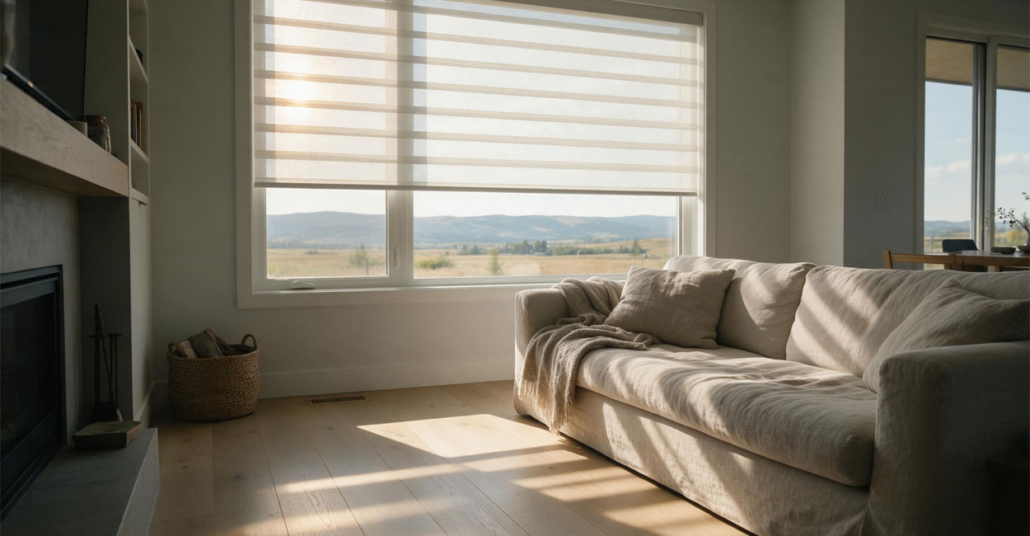
Late summer and early fall in Cochrane has a particular rhythm. The afternoons still carry real heat through south and west facing glass, the evenings cool quickly, and by the time October settles in, the same windows that were letting warmth in are letting it out. Homeowners across Cochrane, Calgary, Bearspaw, Springbank and Bragg Creek deal with this swing every year, and window coverings sit right at the centre of it.
How Much Energy Alberta Homes Lose Through Windows
Glass is the weak point in an otherwise well insulated wall. Natural Resources Canada notes that windows, doors and skylights can account for up to 25 percent of a home’s energy loss. In a climate with a long heating season and wide daily temperature swings, that percentage translates into rooms that never feel settled and utility bills that climb faster than expected.
The encouraging part is that window coverings are one of the more approachable ways to address it. Replacing windows is a large project with a long timeline. Selecting the right treatment for each opening is a considered decision that can be planned now and installed before the cold weather sets in.
What Alberta Windows Are Up Against
A home in Springbank or Bearspaw with generous glazing gets a lot of natural light, which is part of why those windows were specified in the first place. That same glazing creates two seasonal problems.
Through the warmer months, direct sun raises interior temperatures unevenly. Rooms with west exposure become uncomfortable by late afternoon, furniture and hardwood fade over time, and air conditioning runs longer to compensate. Through the colder months, the situation reverses. Warm interior air meets cold glass, cools, and drops toward the floor. That movement is the draft people feel when sitting near a window even though the window itself is sealed properly.
How Chinook Temperature Swings Affect Window Treatment Choices
Chinook conditions add another layer. A twenty degree temperature swing over a single day is normal here, and window treatments that work well in one condition may not adapt well to the other. This is why a single product applied across an entire home rarely serves every room equally.

How Window Coverings Slow Heat Transfer
Heat moves through glass by conduction, convection and radiation. A window covering interrupts all three to varying degrees depending on its construction.
The mechanism that matters is trapped air. Still air is a reasonable insulator. When a treatment holds a layer of air between the fabric and the glass, it slows the exchange between the room and the outdoors. The tighter the seal around the edges of that pocket, the more effective the barrier becomes.
Why Sealed Air Pockets Outperform Loose Hanging Fabric
This is where product engineering makes a measurable difference. A treatment that hangs loosely and allows air to circulate freely behind it will look attractive but contribute little thermally. A treatment designed with a sealed or semi sealed air pocket performs differently, and the performance is documented rather than assumed.
Cellular Shades and the Insulating Air Pocket
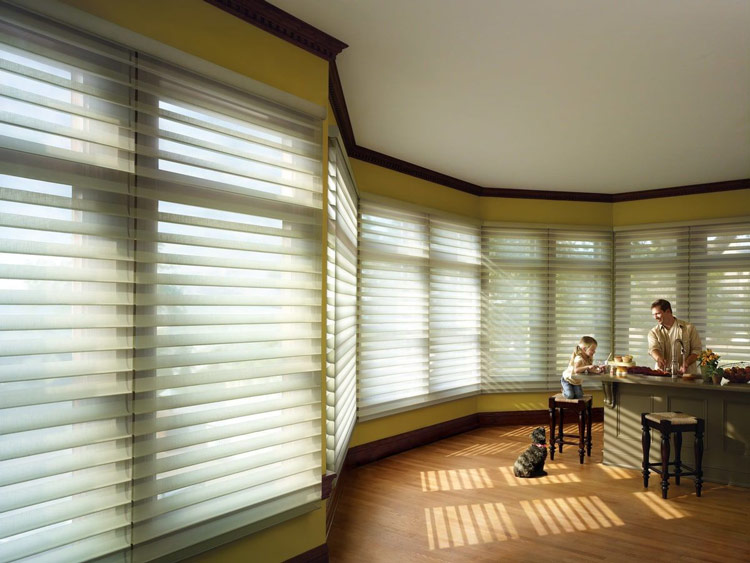
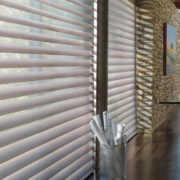
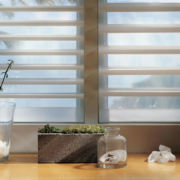
Honeycomb construction is the design most directly aimed at this problem. The pleats form enclosed cells that hold air along the full length of the window. Double cell and “cell within a cell” variations increase the number of air pockets, which increases resistance to heat transfer.
Hunter Douglas publishes energy performance data across its cellular lines, and options such as room darkening and blackout fabrics add light control on top of the thermal benefit. For a bedroom that faces east in a home where someone works nights, or a media room that needs consistent darkness at any hour, the combination addresses both concerns with one product.
Side Channel Systems That Seal the Window Perimeter
Side channel systems take this further by closing the gap along the edges of the shade. Sealing that perimeter reduces both light leakage and air movement, which is why the technology appears in bedrooms and nurseries as often as it does in rooms selected purely for efficiency.
You can review the range of options on our shades page, though the selection process works far more smoothly as a conversation than as a catalogue exercise.
Drapery as a Second Layer
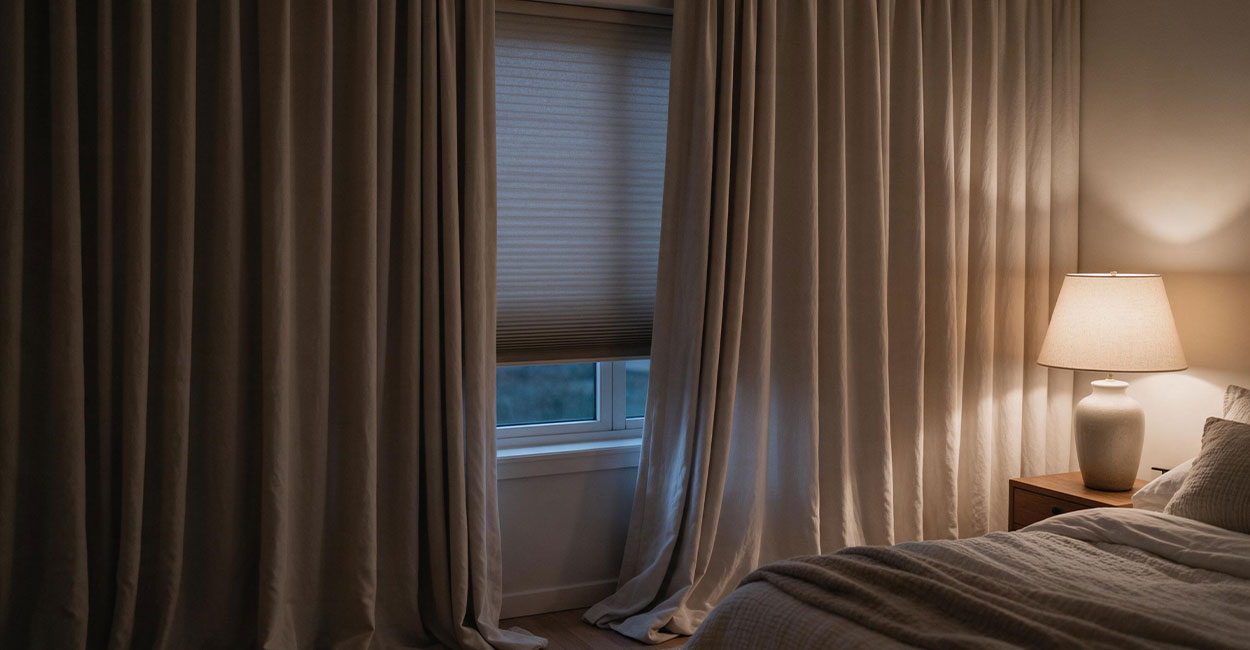
Drapery is sometimes treated as a decorative afterthought, which undersells what it contributes. A lined or interlined panel adds mass in front of the glass, and when it extends past the window frame and reaches close to the floor, it interrupts the convection loop that creates cold air pooling.
Layering Drapery Over Cellular Shades Through the Seasons
Layering also gives a room flexibility. A cellular shade handles daytime light and thermal control, and drapery closes over it in the evening for additional depth and a softer visual finish. During the warmer months the drapery can stay open while the shade does the work.
Choosing Fabric Weight, Lining and Hardware for Alberta Light
Fabric weight, lining choice, header style and hardware placement all influence how well the layer performs and how it reads in the room. Our drapery page covers the range of styles, and fabric selection is one of the areas where an in home consultation earns its value, since colour and texture behave differently under Alberta light than they do under showroom lighting.
Shutters for Rooms That Need a Fixed Solution
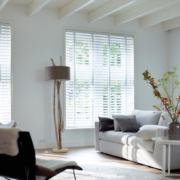
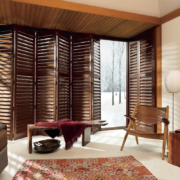
Interior shutters offer a different kind of value. The solid panel construction creates a rigid barrier at the window opening, and the louvres allow directional light control without removing the barrier entirely. Because shutters are built to the specific opening, the fit is close and consistent.
They suit rooms where the window covering is intended to be a permanent architectural element rather than a soft furnishing. Kitchens, bathrooms, entryways and rooms with unusual window shapes are frequent candidates. The build quality also means shutters tend to stay in service across decades rather than product cycles, which matters when weighing initial investment against long term value.
Details on materials, louvre sizes and configurations are available on our shutters page.
Matching Treatments to Room Exposure
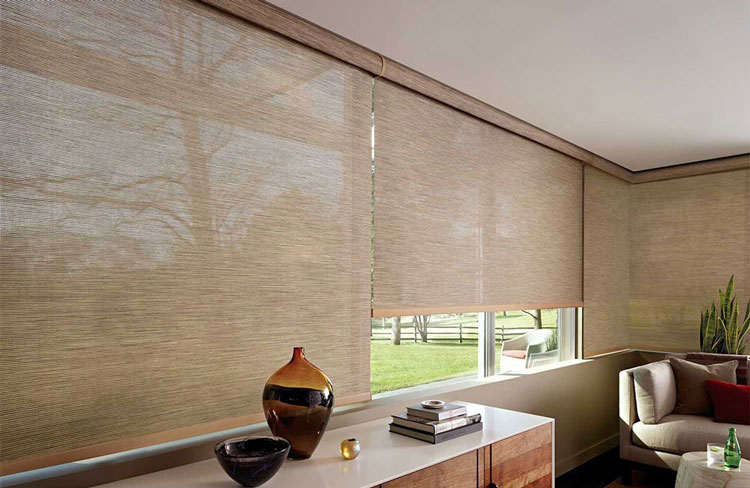
Orientation should drive the specification. South facing windows receive sustained light through the day and carry the widest temperature swing, which makes them strong candidates for cellular construction paired with drapery. West facing rooms take the harshest late afternoon load, and light filtering fabrics with a room darkening option give occupants somewhere to move between comfort and view.
North and East Facing Rooms
North facing rooms lose heat steadily without gaining much solar benefit, so insulating value carries more weight than light control. East facing bedrooms need early morning coverage, which is where blackout fabric and side channels earn their place. Walking through a home room by room is the only reliable way to sort this out.
Motorization and Consistent Daily Operation
Thermal performance depends on the covering actually being in the right position at the right time. A shade that stays open through a hot August afternoon because nobody was home contributes nothing that day.
Scheduled Motorized Shades for Tall and Hard to Reach Windows
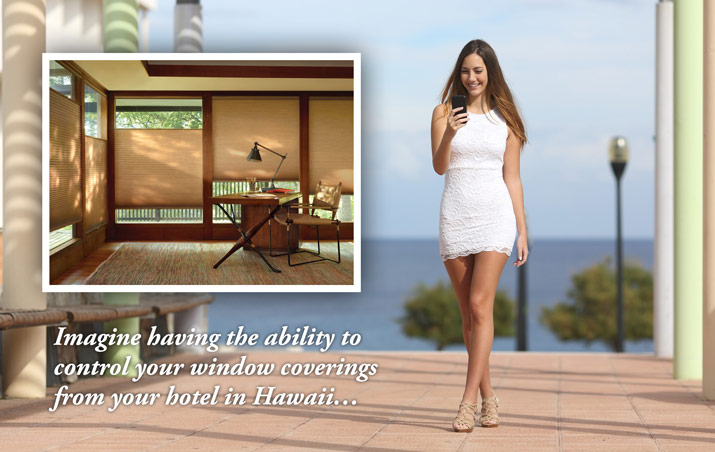
Motorized systems with scheduling remove that dependency. Coverings close during peak afternoon sun in the summer, open to capture solar gain on clear winter mornings, and close again as temperatures drop in the evening. For tall windows, stairwell openings and rooms that are rarely occupied, automation is often the difference between a product that performs on paper and one that performs in practice.
Child Safety and Cordless Operation
Canada regulates this area directly. Health Canada’s Corded Window Coverings Regulations restrict reachable cord lengths and loop sizes in order to eliminate strangulation hazards for children.
Cordless lift systems, motorization and ultraglide wands all meet the requirement while operating cleanly. Families with young children, and anyone with grandchildren visiting regularly, should treat this as a specification item rather than an upgrade. It also produces a cleaner look at the window, which is a reasonable secondary benefit.

Why Measurement and Installation Belong With a Local Professional
Custom window coverings perform to their specification only when the fit is correct. Deductions, mounting depth, bracket placement, squareness of the opening and clearance around cranks and handles all affect whether the finished product seals properly against the glass.
Certified Master Installation and Locally Serviced Warranties
Every project we complete is measured carefully, ordered to those measurements, and installed by a certified Master installer. Many of the products we supply carry a limited lifetime warranty, and that warranty is serviced locally rather than routed through a distant call centre. Homeowners across Cochrane and the Calgary area work with the same consultant from the first appointment through installation and any service that follows.
Planning Ahead of the Colder Seasons
Custom window coverings are manufactured to order, and lead times extend as the fall approaches. Starting the conversation in late summer means the product arrives and is installed before the heating season begins rather than partway through it.
Kirstin Sundgaard brings twenty years of interior decorating experience and Hunter Douglas Consultant certification to every consultation. The process begins with listening: how each room is used, when the sun reaches it, what the space needs to feel like, and what the budget allows. From there the recommendations follow the home rather than a template.
If your windows have been working against you through the seasons, now is a sensible time to address it. Contact Blind Infusion to arrange your consultation, or call (403) 801-6434 to speak with Kirstin directly about your Cochrane, Calgary, Bearspaw, Springbank or Bragg Creek home.